
How to Dice an Onion With an 8-Inch Chef Knife
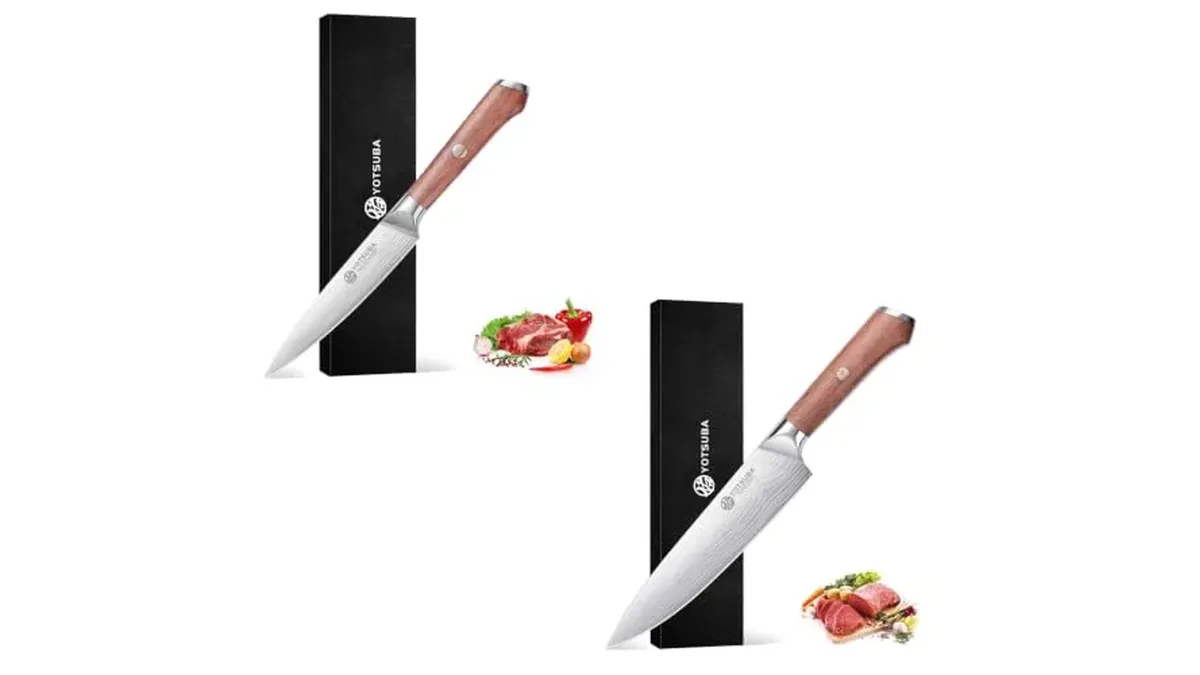
An 8-inch chef knife is the right length for an onion: long enough to finish each cut in one motion, short enough to steer. On this site that blade lives in the Utility + 8" Chef Pair on the Chef's Knives page, bundled with a 5-inch utility knife for the small follow-up work.
The knives you are using
Yotsuba publishes these facts for the pair:
- 8-inch Japanese chef knife with a 2 mm blade and a hand-polished edge.
- 5-inch utility knife, high-carbon steel rated 56+ HRC, hand-sharpened to 14° per side.
- Full-tang rosewood handles on both knives.
- Gift packaging. The two knives are sold as a bundle and may ship separately.
Hardness and edge angle are stated for the utility knife only, not for the chef knife. That 2 mm chef blade is why a push cut parts an onion instead of wedging it into crushed layers. Keep the 5-inch utility nearby for shallots, garlic, or any piece that feels clumsy under an 8-inch blade.
Use a wood or soft plastic board. Dry the onion and the board so the bulb does not skate.
Grip and guide hand
Pinch the blade just ahead of the handle between your thumb and the side of your index finger, then wrap the other three fingers around the rosewood handle. Curl the fingertips of your guide hand under, knuckles forward, so the flat of the blade rides against your knuckles. This is the same starting position used in how to use a Yotsuba chef knife.
Step 1: Top, root, and first half
Slice a thin cap off the stem end so the onion sits flat. Leave the root intact. The root is the hinge that holds layers together; if you trim it off now, the onion falls into loose petals and the dice turns ragged.
Stand the onion on that new flat face and cut straight down through the stem end toward the root, splitting it into two halves. Peel the skin from each half. If a dry outer layer still clings near the root, tease it off with your fingers rather than sawing it with the edge.
Step 2: Horizontal cuts
Lay one half cut-side down, root pointing to the side opposite your knife hand (to the left if you cut right-handed). Place your guide hand on top. With the tip of the 8-inch blade aimed toward the root, make one or two horizontal cuts parallel to the board, stopping just before the root. For a fine dice, use two horizontal passes; for a medium stew dice, one may be enough.
Keep the blade level. The 2 mm profile helps here because you can steer a thin cut without the spine forcing the layers apart. Do not cut through the root. That last uncut block is what keeps the half from collapsing.
If you only need a rough chop for a long simmer, you can skip the horizontal cuts. The cubes will be less even.
Step 3: Vertical slices toward the root
Still holding the half together, make several downward slices from the stem face toward the root, like spokes that never quite reach the hub. Space them closer for a fine dice, wider for soup. Stop short of the root.
Use a gentle push-forward-and-down motion rather than a heavy chop that smashes the layers. Yotsuba describes that push cut as the motion for onions and peppers: tip slightly raised, then forward and down so the blade slices instead of crushing.
Step 4: Cross-cuts that make the dice
Turn the half so the root end faces your guide hand, or simply rotate it so you can cut across the slices you just made. Starting at the stem face, push-cut across the onion in even increments. Cubes should fall away with each pass. When you reach the root block, set that piece on its side and slice it into the last few cubes, or save it for stock.
Work through the second half the same way. A sharp, thin blade reduces crushing, which also sends less vapor toward your face.
Fine dice, medium dice, and when to switch knives
- Fine dice: two horizontal cuts and tight vertical spacing. Good for sauces and raw onion that should disappear into a dish.
- Medium dice: one horizontal cut and wider spacing. Good for sautés and soups.
- Rough chop: skip the horizontals and cut thicker slices, then cross-cut. Good when the onion will cook down for a long time.
Switch to the 5-inch utility when the piece is a shallot, a garlic clove, or a sliver that the 8-inch chef knife feels clumsy on. Yotsuba also names in-between jobs for that utility: trimming, segmenting citrus, and other small board work. Its published 14° edge is the figure to match if you later sharpen that smaller knife; see what angle to sharpen a Japanese knife.
Safety and edge care while you dice
Wash both knives by hand and dry them right away. Keep the edges off bones and frozen food. Scrape chopped onion across the board with the spine, not the edge. Hone lightly before a longer prep session if you already use a honing rod, and store the pair so the edges do not knock against other steel.
If you are choosing between this chef shape and a flatter vegetable profile, gyuto vs santoku vs nakiri maps the difference. Larger kits live under Knife Sets. The wider lineup is in the Yotsuba review.
A clean onion dice is mostly sequence: root on, horizontal cuts, vertical slices, then cross-cuts. The 8-inch chef knife does the board work; the 5-inch utility takes over when the pieces get small.