
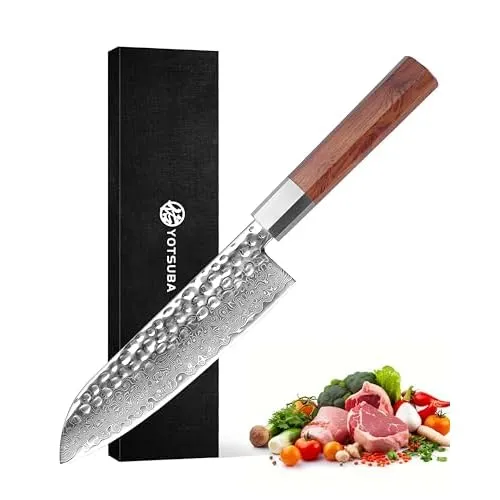
Damascus, three pieces
3PCS Damascus Knife Set
Three-piece Japanese-style set—8" chef, 7" nakiri, and 5" utility—with 67-layer Damascus high-carbon steel (~62 HRC), ~2 mm blades, anti-stick grooves, and an octagonal olive-wood handle. Gift-boxed.
Who it fits, what you get, and what to check before you buy.
Damascus, three pieces
Three-piece Japanese-style set—8" chef, 7" nakiri, and 5" utility—with 67-layer Damascus high-carbon steel (~62 HRC), ~2 mm blades, anti-stick grooves, and an octagonal olive-wood handle. Gift-boxed.
A three-knife Japanese-style set that stands out in the Yotsuba lineup for 67-layer Damascus steel around 62 HRC, ~2 mm blades with anti-stick grooves, and an octagonal olive-wood handle. Best if you want a compact patterned set and do not need a block or steak knives. For the steel and edge figures of every Yotsuba kit next to this trio, see our Yotsuba review.
The set includes an 8" chef knife, a 7" nakiri, and a 5" utility knife. That mix covers general chopping, vegetable work, and smaller prep without a long carving blade or bread knife.
The 8" chef knife, which Yotsuba calls a gyutou, is the all-rounder: slicing, dicing and mincing vegetables and boneless meat. The 7" nakiri has a squared-off, flat edge that meets the board along its whole length, so it push-cuts vegetables cleanly without rocking. The 5" utility handles the small jobs, such as trimming, shallots and fruit. If the difference between gyuto and nakiri is new to you, Gyuto vs Santoku vs Nakiri goes through it shape by shape.
Cooks who want fewer, more distinctive knives; gifters who like patterned steel; kitchens that already own a bread knife or prefer boards over a full block.
Buyers who need steak knives, a block, or a fillet blade should open the 15-piece block, the 7PCS rosewood set, or the fillet bundles instead.
Compared with Milano rosewood sets at about 56 Rockwell, this trio’s ~62 HRC Damascus makes it the harder-steel pick in the range. Compared with the 15-piece block, you trade piece count and steak knives for patterning and a smaller gift box. Compared with fillet bundles, you do not get a flexible fish blade—nakiri covers vegetables instead.
Harder steel is the reason to buy this set and the reason to handle it with some care. A thin, hard edge stays sharp longer, but it can chip if it meets bone, frozen food, a glass or stone board, or a sideways twist. Cut on wood or soft plastic, lift the nakiri rather than scraping food across the board with the edge, and use the back of the blade to sweep. Hone lightly and sharpen on a whetstone when the edge stops biting.
Yotsuba doesn't print dishwasher guidance for this set, so wash each knife by hand, dry it at once and store it in the gift box or a block; Damascus steel looks its best when it isn't left wet. Use the shop links on the product page to pick the exact version you need.